Whether you're a student looking for your first job, a recent graduate, or in the middle of a career change, you've probably wondered how to create a great resume that immediately catches attention. Good news: with the right tips, it's absolutely achievable. There's one thing worth keeping in mind though: most large companies now use ATS software to pre-screen applications. We'll show you how to make sure your resume passes this step. Follow this guide to discover practical tips, examples tailored to tech, finance, and aviation, and leave motivated to land your next interview.
Polish the Presentation: Form Matters as Much as Content
The first impression comes from your resume's appearance. A recruiter will first skim the structure before reading in detail, so it's crucial to perfect the visual presentation.
Clarity and Structure
Opt for an airy layout with clearly defined sections and explicit headings (Education, Experience, Skills...). Use a classic font (Arial, Calibri, Times New Roman) in size 11 or 12, with sufficient line spacing (~1.15) to facilitate reading.
Professional Sobriety
Favor neutral colors (black, navy blue, gray) and one or two fonts maximum. Excessive flourishes or overly busy designs can distract from the content. A touch of color can help distinguish certain parts, but stay elegant and consistent.
Ideal Length
At the start of your career, it's generally recommended to stick to a single page. This forces you to synthesize the essentials of your background and demonstrates your ability to be concise. If you have many experiences, two pages may be considered, but never more.
No Detail Left to Chance
Meticulously check spelling and grammar – zero errors is the golden rule! A typo or language mistake can give employers an image of carelessness. Don't hesitate to have someone else proofread your resume. Also make sure your contact information is up-to-date and professional.
PDF Format Recommended
For digital submissions, send your resume as a PDF to preserve the layout on all devices. Name the file explicitly (e.g., Resume_FirstName_LastName.pdf) to show professionalism right down to the file name.
Hook and Content Structure: Capture Attention from the Start
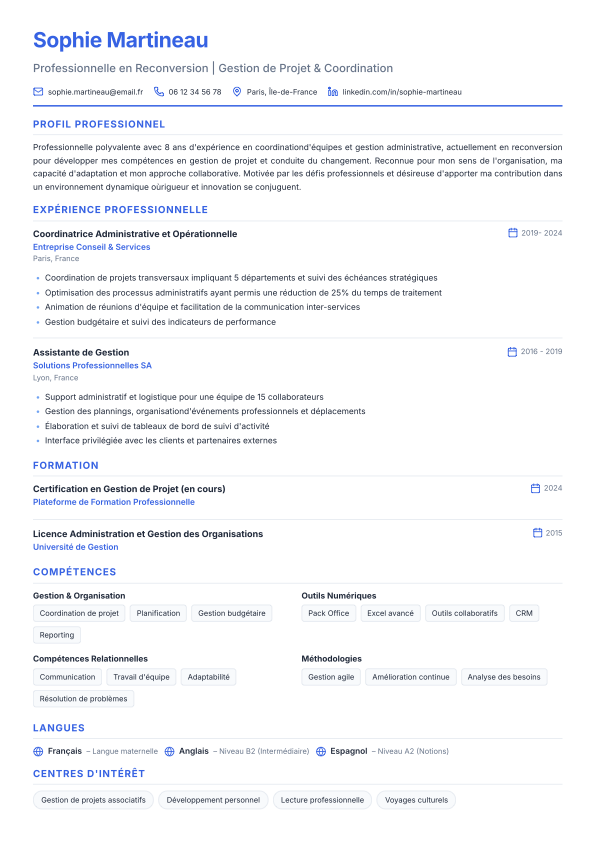
A tip to stand out from the first lines is to add a title and possibly a hook at the top of your resume. The resume title is usually the job title you're seeking or your profile.
Title and Hook
Just below the title, you can insert a few hook sentences summarizing your main strengths. This is a mini introductory paragraph that should make people want to meet you.
"Computer science graduate, passionate about web development, I've completed several academic projects as part of a team and I'm looking to put my JavaScript and Python skills to work for an innovative startup."
Structure the Rest of the Content
- Education or Experience First? - If you're a student or recent graduate with little experience, place the Education section at the top. However, if you already have some relevant professional experience, the Experience section should appear first.
- Detail Your Experiences Concretely - For each job, internship, or project, describe in 2-3 bullet points what you did using action verbs ("Developed...", "Analyzed...", "Managed...") and if possible, quantified results.
- Skills - Keep a separate section for your technical and language skills. Only include those relevant to the target position.
Interests
Don't forget the Interests or Extracurricular Activities section, especially if you're a junior. A clever tip: rename "Interests" to "Also..." for a more friendly tone. Select hobbies that highlight qualities valued in the position.
Customize for Each Application: Tailor Your Resume to the Position
An effective resume is never completely "general": it must be tailored for each opportunity. Carefully analyze the job posting and identify the main keywords.
- Integrate keywords from the offer (technical skills, qualities, required tools) into your resume
- Use the exact job title in your resume title
- Prioritize information based on what matters most to the employer
For Career Changers
You can opt for a skills-based (thematic) resume that emphasizes your transferable skills and abilities rather than your previous positions. Start with an explicit title like "Former teacher transitioning to web development". Highlight your transferable skills: analytical thinking, project management, communication.
Make Your Resume ATS-Friendly
ATS (Applicant Tracking System) software is used by many companies to pre-screen applications. To ensure your resume is properly read by these tools, a few best practices are all you need: use a simple layout without multiple columns, choose classic fonts (Arial, Calibri), structure your sections with standard titles (Experience, Education, Skills), and avoid replacing text with icons or graphics. By naturally integrating keywords from the job posting, you maximize your chances. Tools like Fileify generate resumes designed to be ATS-compatible, which simplifies the process.
Differentiating Tips to Stand Out
Beyond adjusted content and good presentation, here are some honest and effective tips to make a difference:
- Personalized Header - Add a link to your LinkedIn profile or an online portfolio. A discreet QR code leading to your portfolio can be an innovative plus for a tech or creative profile.
- Quantify Your Accomplishments - Talk about "20% increase in sales", "5 events organized gathering 300 people", or "self-taught learning of 2 new languages in 6 months". These factual elements leave a lasting impression.
- Avoid Clichés - Ban banalities like "perfectionist", "good communication" without context. Prefer to show these qualities through your experiences.
- Personalize the Design - For a resume in tech or design, you can use a modern two-column layout. For a traditional sector like finance, stay sober and very professional.
- Adapt to Industry Standards - In hospitality or aviation, it's common to include a professional photo. In tech, the photo isn't necessary – technical content will prevail.
- Intelligently Rename Sections - Title your hook "Profile" or "About Me". If you're changing careers, title your section "Professional Experience and Projects" to include personal projects.
Concrete Examples of Compelling Resumes (Tech, Finance, Aviation)
To help you visualize these tips, here are three resume examples adapted to entry-level profiles in three different sectors. For each, we offer a ready-to-use prompt for Fileify.
Junior Web Developer Resume (Tech Sector)
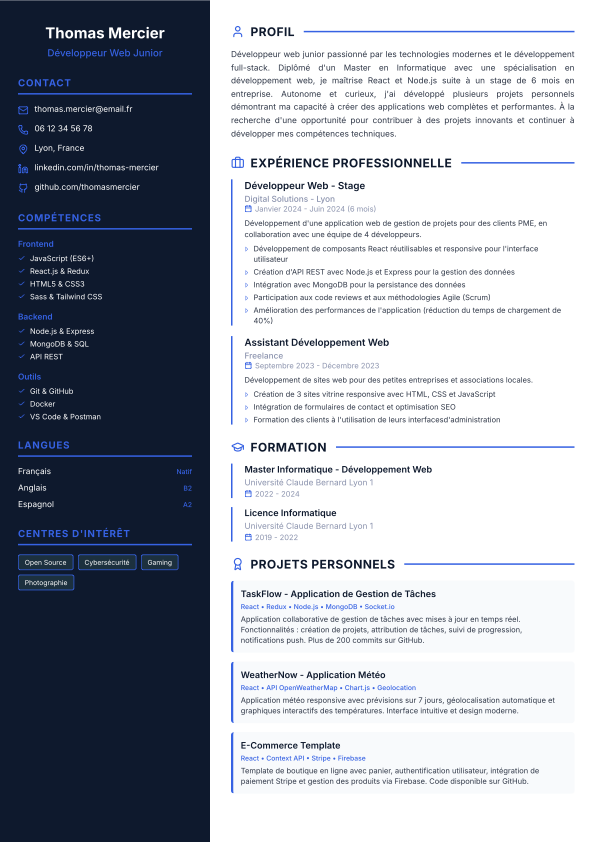
In tech, a junior developer's resume should highlight acquired technical skills and concrete projects completed, even academic ones. Mention the languages and frameworks you've mastered, your school projects, and possibly your open-source contributions.
Entry-Level Financial Analyst Resume (Finance Sector)
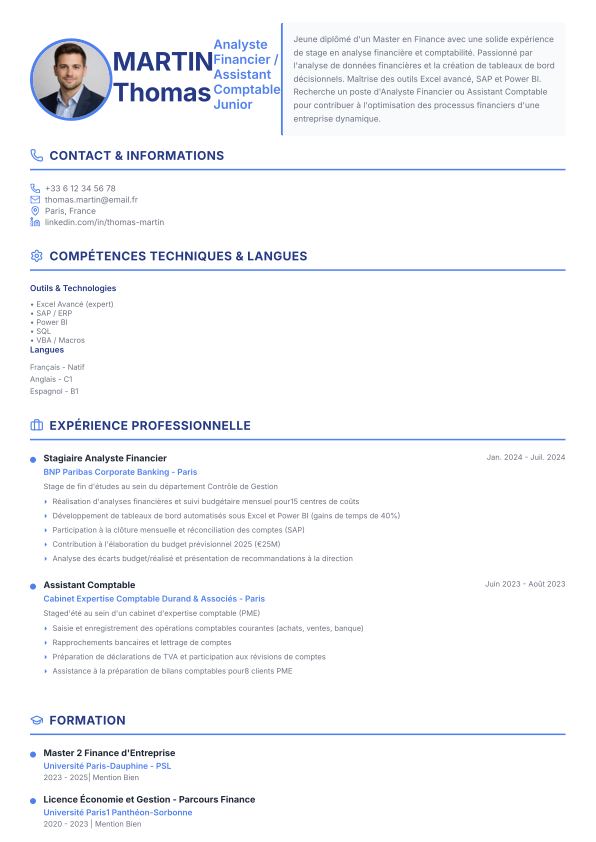
For an entry-level finance profile, the resume should exude seriousness, reliability, and rigor. Highlight your finance education and internship or work-study experiences. Showcase your technical skills (Excel, SAP, accounting standards).
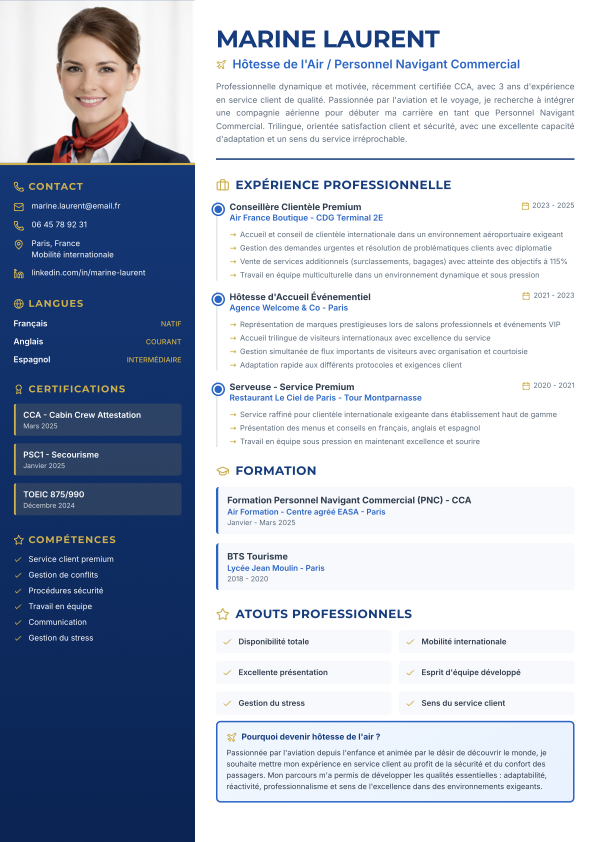
Flight Attendant Resume (Aviation Sector)
In the aviation sector, recruiters look for candidates with excellent service skills and language abilities. Highlight any customer service experience and clearly indicate your spoken languages with proficiency levels.
Ready to Create Your Winning Resume?
As you've understood, writing a compelling resume takes some thought and customization – but it's an investment worth making to land your dream job. By applying these concrete tips, your resume will not only look great, but it will especially highlight what makes you unique as a candidate. Every detail, from word choice to the quantified examples you cite, helps tell your story in a convincing and authentic way.
Create Your Resume with Fileify
Smart tools like Fileify are here to simplify the task. In just a few clicks, generate a personalized and optimized resume, ready to be refined to your taste. It's simple, fast, and intelligent.
Create My Resume Now